

Webhook events
ZapSMTP POSTs a JSON event to your endpoint for every recipient and every change. Answer with any 2xx within a few seconds; do the work afterwards.
email.sent | Accepted for delivery. |
|---|---|
email.delivered | The receiving server accepted the message. |
email.delivery_delayed | A temporary failure; we keep retrying. |
email.bounced | Permanently rejected, or retries ran out. |
email.complained | The recipient marked it as spam. |
email.failed | Rejected before sending. |
email.opened | The tracking pixel loaded (open tracking on). |
email.clicked | A tracked link was clicked (click tracking on, or a link with a click action). |
email.suppressed | Not sent: the recipient is on your suppression list. |
email.received | An inbound email arrived. Metadata only, unless the endpoint has include_content: then text, html, headers and 24-hour download links for attachments and the raw message (cut at 1 MB, truncated: true). |
thread.created | A new conversation: a received email that answers nothing. Not sent for automated mail. |
thread.replied | A customer answered in a conversation. Not sent for auto-replies, bounces and notifications. |
email.replied | Someone answered an email sent with reply tracking. Sent for every tracked reply, automated ones included; data.reply.type tells them apart. |
Payload
One event per recipient: data.to is a single address. bounce appears on bounced, delayed, failed and suppressed events; click and open carry the link, IP and user agent; click.action names a link marked with a click action, and click.unique, present on every click, is true on the first click of that action by that recipient of that email and false on later clicks and on links without an action; email.opened and email.clicked carry the email’s metadata and tags when each fits in 200 bytes; and open.machine is true when Apple Mail Privacy Protection loaded the pixel (such opens may not be a person reading; they still count as opens, and metrics split them out as human_opened / human_open_rate); test is true for test keys. tls (version, e.g. TLSv1_3, and cipher) appears when the attempt reached the receiving server over TLS.
email.replied carries reply: email_id (the received reply, readable with GET /emails/receiving/{id}; data.email_id is the email that was answered), from, from_name, subject, text (the reply without the quoted email, at most 2,000 characters), type (human, unsubscribe, out_of_office, auto_reply, auto_generated, bounce or bulk), is_spam, sender_matches_recipient (the replier was one of the email’s To or Cc recipients; data.to then names them, otherwise it is empty) and forward: {to, status, reason}, where status is queued or skipped and reason is spam, automated, unsubscribe, not_allowed or no_destination.
email.received, thread.created and thread.replied have their own data (see Receiving email) and no top-level id: dedupe them on the Zap-Event-Id header.
{
  "id": "evt_5f0c2a9b7d1e4c3a8b6f2e10",
  "type": "email.bounced",
  "created_at": "2026-10-21T15:04:12.381Z",
  "data": {
    "email_id": "019a1f2e-7c3b-7d41-9a52-0c4b8e6f1a23",
    "from": "Acme <hello@acme.com>",
    "to": "jane@example.org",
    "subject": "Your receipt",
    "tags": {
      "category": "receipt"
    },
    "metadata": {
      "order_id": "A-1042"
    },
    "stream": "transactional",
    "thread_id": "3f1c9a52-6b0e-5d4f-8a71-2c9e0b4d6f13",
    "attempts": 1,
    "response": {
      "code": 550,
      "message": "5.1.1 The email account that you tried to reach does not exist"
    },
    "bounce": {
      "type": "Permanent",
      "subType": "MailboxDoesNotExist",
      "message": "5.1.1 The email account that you tried to reach does not exist",
      "suppressed": true
    }
  }
}
An email.clicked event:
{
  "id": "evt_7a1d0c3e9b2f4a6c8e5d1b07",
  "type": "email.clicked",
  "created_at": "2026-10-27T08:41:05.214Z",
  "data": {
    "email_id": "019a1f2e-7c3b-7d41-9a52-0c4b8e6f1a23",
    "from": "<@acme.com>",
    "to": "jane@example.org",
    "tags": {
      "category": "receipt"
    },
    "metadata": {
      "order_id": "A-1042"
    },
    "stream": "transactional",
    "click": {
      "link": "https://acme.com/orders/A-1042/confirm",
      "action": "confirm_order",
      "unique": true,
      "ip_address": "203.0.113.24",
      "user_agent": "Mozilla/5.0 (Macintosh; Intel Mac OS X 10_15_7) AppleWebKit/605.1.15 (KHTML, like Gecko) Version/18.1 Safari/605.1.15"
    }
  }
}
An endpoint with filter.actions receives email.clicked only for those actions; see Send actions to their own endpoints.
Zap-Signature | t=<unix seconds>,v1=<hex HMAC-SHA256>. After you rotate the secret, both secrets sign for 24 hours and the header carries two v1 values. |
|---|---|
Zap-Event-Id | Stable across retries and replays. Store it and skip events you have already processed. |
Zap-Webhook-Id | The endpoint that this delivery is for. |
Verify signatures
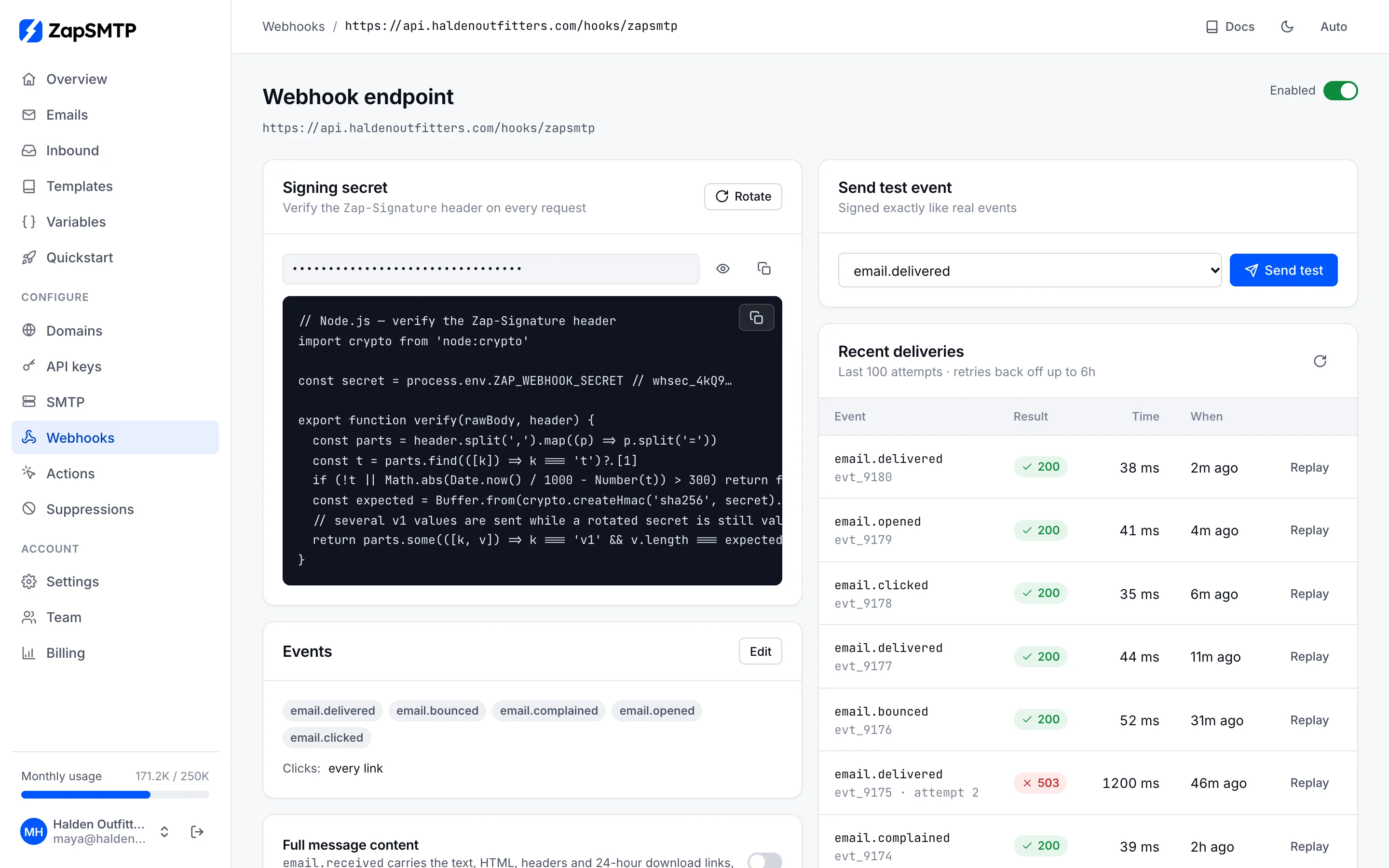
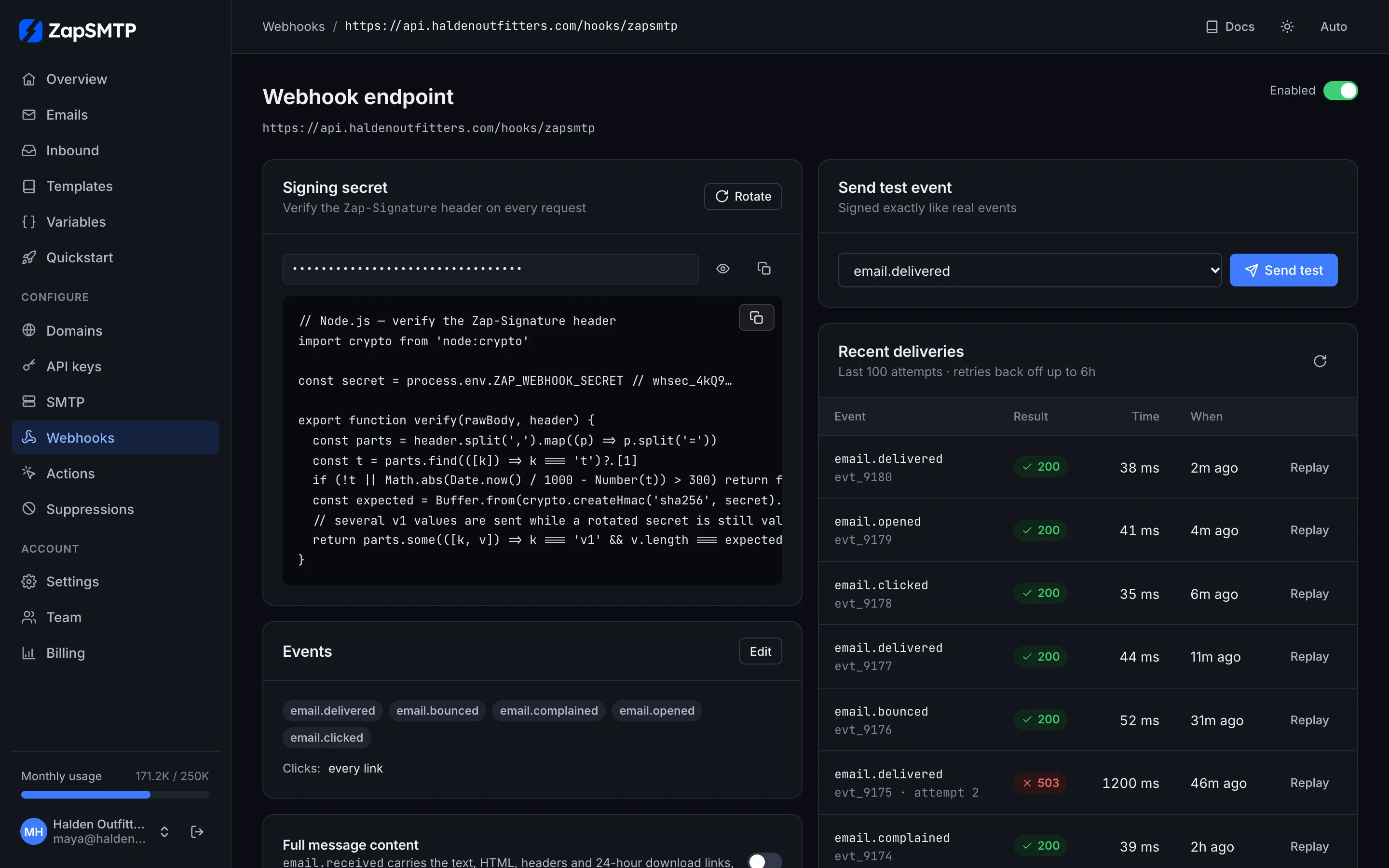
Compute HMAC-SHA256 with your endpoint’s secret (the whole string, including whsec_) over <t>.<raw body> and compare it, in constant time, with each v1 value. Reject timestamps older than five minutes. Always use the raw request body: re-serialized JSON will not match.
import crypto from 'node:crypto';
import express from 'express';

const app = express();
// keep the raw body: the signature covers the exact bytes
app.post('/hooks/zapsmtp', express.raw({ type: 'application/json' }), (req, res) => {
  const header = req.get('Zap-Signature') ?? '';
  const parts = header.split(',').map((p) => p.split('='));
  const t = parts.find(([k]) => k === 't')?.[1];
  const sigs = parts.filter(([k]) => k === 'v1').map(([, v]) => v);
  const expected = crypto.createHmac('sha256', process.env.ZAP_WEBHOOK_SECRET)
    .update(`${t}.${req.body}`).digest('hex');
  const fresh = Math.abs(Date.now() / 1000 - Number(t)) < 300;
  const ok = fresh && sigs.some((s) => s.length === expected.length &&
    crypto.timingSafeEqual(Buffer.from(s), Buffer.from(expected)));
  if (!ok) return res.sendStatus(400);

  const event = JSON.parse(req.body);
  // dedupe on req.get('Zap-Event-Id'): retries repeat the same id
  res.sendStatus(200);
});
import hashlib, hmac, os, time
from flask import Flask, request, abort
app = Flask(__name__)
@app.post("/hooks/zapsmtp")
def zapsmtp():
parts = [p.split("=", 1) for p in request.headers.get("Zap-Signature", "").split(",")]
t = next((v for k, v in parts if k == "t"), "0")
sigs = [v for k, v in parts if k == "v1"]
expected = hmac.new(os.environ["ZAP_WEBHOOK_SECRET"].encode(),
f"{t}.".encode() + request.get_data(), hashlib.sha256).hexdigest()
if abs(time.time() - int(t)) > 300 or not any(hmac.compare_digest(s, expected) for s in sigs):
abort(400)
event = request.get_json()
return "", 200<?php
$body = file_get_contents('php://input');
$t = null; $sigs = [];
foreach (explode(',', $_SERVER['HTTP_ZAP_SIGNATURE'] ?? '') as $part) {
[$k, $v] = array_pad(explode('=', $part, 2), 2, '');
if ($k === 't') $t = $v;
if ($k === 'v1') $sigs[] = $v;
}
$expected = hash_hmac('sha256', $t . '.' . $body, getenv('ZAP_WEBHOOK_SECRET'));
$valid = abs(time() - (int) $t) < 300
&& count(array_filter($sigs, fn ($s) => hash_equals($expected, $s))) > 0;
if (!$valid) {
http_response_code(400);
exit;
}
$event = json_decode($body, true);
http_response_code(200);func zapsmtp(w http.ResponseWriter, r *http.Request) {
body, _ := io.ReadAll(r.Body)
var t string
var sigs []string
for _, part := range strings.Split(r.Header.Get("Zap-Signature"), ",") {
k, v, _ := strings.Cut(part, "=")
switch k {
case "t":
t = v
case "v1":
sigs = append(sigs, v)
}
}
mac := hmac.New(sha256.New, []byte(os.Getenv("ZAP_WEBHOOK_SECRET")))
mac.Write([]byte(t + "."))
mac.Write(body)
expected := hex.EncodeToString(mac.Sum(nil))
ts, _ := strconv.ParseInt(t, 10, 64)
ok := false
for _, s := range sigs {
ok = ok || hmac.Equal([]byte(s), []byte(expected))
}
if !ok || time.Since(time.Unix(ts, 0)).Abs() > 5*time.Minute {
http.Error(w, "bad signature", http.StatusBadRequest)
return
}
w.WriteHeader(http.StatusOK)
}require 'openssl'
require 'rack/utils'
post '/hooks/zapsmtp' do
body = request.body.read
parts = request.env['HTTP_ZAP_SIGNATURE'].to_s.split(',').map { |p| p.split('=', 2) }
t = parts.find { |k, _| k == 't' }&.last.to_s
sigs = parts.select { |k, _| k == 'v1' }.map(&:last)
expected = OpenSSL::HMAC.hexdigest('SHA256', ENV.fetch('ZAP_WEBHOOK_SECRET'), "#{t}.#{body}")
fresh = (Time.now.to_i - t.to_i).abs < 300
halt 400 unless fresh && sigs.any? { |s| Rack::Utils.secure_compare(s, expected) }
event = JSON.parse(body)
200
endCheck a signature here
Paste a secret and a body to get the header we would send, or paste a received header to check it. Everything runs in your browser.
Batched delivery
For high volumes, turn on batch when you create or update an endpoint. Events then arrive up to 100 per request, or whatever arrived within a second, as a JSON array of the usual event objects. The array is signed as one body, exactly like a single event. Zap-Event-Id is the batch’s id, the same on every retry. Each event in it keeps its own id, so dedupe per event (email.received and thread events have no id: dedupe those on type plus data.email_id). A failed batch is retried as it was, with the same schedule as single events. email.received with include_content still arrives on its own.
How fast ZapSMTP sends adapts to your endpoint. Requests in flight start at 32. They grow while your endpoint answers quickly, and halve when it times out or answers 5xx or 429. A slow endpoint is not flooded, and a fast one is not held back.
Retries
Network errors, timeouts, 5xx, 408 and 429 are retried after 5 s, 5 min, 30 min, 2 h, 5 h, 10 h and 10 h — eight attempts over about 28 hours. Other 4xx answers are final. An endpoint that keeps failing is paused for a minute without losing attempts, and is disabled if five events exhaust their retries within 24 hours (re-enable it with PATCH). The last 100 attempts are kept: list them and replay any event.